
Eteocretan Language Pages
 Home Page
 Credo pages
 Genealogy
 Eteocretan language
 Glosso-poeia
 "The
"TheThe "Epioi" fake
(a.k.a. the Psychro insciption)
This "biscript" inscription, which has now been shown to be a modern fake,
is given here for the sake of completeness, as it has figured in several publications about Eteocretan. The brevity of
the inscription has made it painfully easy to read practically any language one wishes into this inscription; nevertheless, this
has not prevented some scholars "translating" the biscript. For the curious, some claimed "translations"
are given on a separate page; they are, in my opinion, yet more examples of how not to translate.
Foreword: What I have & have not said not said about this inscription
I have discovered at least three sites on the Internet that have misrepresented what I have said about this inscription. However, misrepresenting me in order to set up a straw man to be knocked down does nothing to prove whether the inscription is genuine or not. It is Ch. B. Kritzas who has given definitive evidence that this is a fake; I have seen no convincing counter arguments to his evidence.
Nevertheless, as I have been misrepresented, I would like at the outset to set the record straight:
- 1. I have never proffered or attempted any serious translation of the Greek letters on this inscription
- While I was doing my research in the late 1970s, several scholars I spoke to at the time commented that the inscription looked odd, particularly as some
of the words appeared to be Greek. Indeed, three of the words could be valid ancient Greek words. It is, therefore, tempting to read
the inscription as Greek. I realized, however, that if it was obviously Greek, a Greek translation would have been accepted long ago. What I
was doing in writing to Dr J. Chadwick was to get clarification as to why it could not be Greek.
At no time have I seriously suggested the inscription was Greek and I explicitly said of my so-called "Celtic translation" that it was "an exercise to show how a language can too easily be forced into an inscription such as this one" [R.A. Brown, Pre-Greek Speech on Crete, Amsterdam, 1984, page 343]. The idea that it is actually Celtic is, in my opinion, quite absurd.
- 2. I have always and consistently held that the three "Linear" symbols have no phonetic value
- Pavel Serafimov in his article "TRANSLATION
OF ETEOCRETAN EPIOI INSCRIPTION" states that: "Brown … reads the sign combination as RE-A-NJA." This is quite incorrect.
The values to which Serafimov refers were given in the "exercise to show how a language can too easily be forced into an inscription such as this one"; it was done in deliberate parody of the too many "translators" who have given values to these symbols with little or no discussion.
In my 1982 thesis I wrote: "Therefore, that they are 'magic' signs rather than script signs seems the most credible suggestion" [R.A. Brown, op.cit., page 236]. I now think that the three symbols were appended by the forger, who had probably seen Linear A symbols, to add mystery to his forgery. If this is so, then he has most surely been successful!
- 3. That I found the inscription suspect because I could not translate it is quite ludicrous
- In my 1982 thesis I observed:
- the text, apparently written in the Ionic alphabet of the 3rd century BCE, "is peculiar in that it finishes with three signs of Linear A appearance".
- "Another odd thing about this inscription is that three of the five words could be Greek".
- "If a non-Greek origin is attributed to this inscription, it is not clear that the language is the same as that of D2, D7, P1, P2 and P3", i.e. the language does not bear any obvious resemblance to that of the Eteocretan inscriptions from Dreros and Praisos.
Thus clearly I had found the inscription suspect at that time. When I put the Eteocretan pages online in 2003 I repeated that I found the inscription suspect.
The idea, which I have encountered, that I found it suspect (and now consider it a fake) because I was unable to translate it, is quite ludicrous. I cannot translate the Dreros or Praisos inscriptions; yet I have no doubt that they are authentic. I considered the inscription suspect because the three oddities I have noted above did not (and do not) appear to harmonize or cohere.
- 4. That I think there can be only one non-Greek language spoken in Crete is false.
- Also ludicrous and, indeed, quite false is the notion that because "the language does not bear any obvious resemblance to that of the Eteocretan inscriptions from Dreros
and Praisos" I naively thought there could be only one non-Greek language on Crete. Ancient tradition is that there were at least two non-Greek languages there:
Kydonian and Eteocretan. Also Linear A still awaits generally accepted
decipherment so we do not know whether "Minoan" is a single language or not nor whether it is related to Eteocretan or not. I have always held that more
than one non-Greek language is likely to have been spoken on Crete. As Yves Duhoux has observed:
"nous parlons tous de « Minoens » et de « substrat ». Ces étiquettes sont commodes, mais ont le défaut de faire presque nécessairement croire que la réalité qu'elles désignent était, comme elles, simple et unique. La vérité était très probablement différente et bien plus complexe."
[Yves Duhoux, "Margalit FINKELBERG, Greeks and Pre-Greeks. Aegean Prehistory and Greek Heroic Tradition", in L'Antiquité Classique 76, 2007, pp. 376-377].To which I say "AMEN!"
The reason I now hold that it is a forgery is that, in my opinion, the evidence presented by Dr Kritzas puts beyond doubt that the inscription is a modern fake [Ch. B. Kritzas, The "Bilingual" inscription from Psychro (Crete). A coup de grâce, in Gigli, R. (ed.), Μεγάλαι Νῆσοι Studi dedicati a Giovanni Rizza per il suo ottantesimo compleanno, Catania 2004 [in fact, published in May 2006], I, 255-261].

Introduction
The brick fragment with the inscription, now known to be a modern fake, was part of the private collection of Dr Stylianos Giamalakis. The date of its purchase and of its discovery are unknown.
According to Spyridon Marinatos ("Γραμμάτων διδασκάλια", Minoica: Festschrift zum 80. Geburstag von Johannes Sundwall, Berlin, 1958, p. 227), he was told by Dr Giamalakis that it had been found in the vicinity of the village Psykhro on the Lasithi Plateau near to the once sacred cave, identified by excavators and several scholars with the Diktaian Cave of the ancient Greeks and, indeed, used as a place of cult since Neolithic times.
Following Marinatos' publication, S. Davis (The Phaistos Disk and the Eteocretan Inscriptions from Psychro and Praisos, Johannesburg, 1961; The Decipherment of the Minoan Linear A and Pictographic Scripts, Johannesburg, 1967), C.H. Gordon (Evidence for the Minoan Language, New Jersey, 1966), R. Stieglitz ("The Eteocretan inscription from Psychro", Kadmos 15, Berlin, 1976, pages 84-86) and myself ( "The Eteocretan inscription from Psychro", Kadmos 17, Berlin, 1978, pages 4-46; Pre-Greek Speech on Crete, Amsterdam, 1984) repeated this ascription to the Psykhro area. In my case I was unaware at the time that this was uncertain and, I assume, so were these other authors.
However, the handwritten catalog of the Giamalakis collection, preserved in the archaelogical Museum at Iraklion, gives a different location: the village of Ini in the province of Monofatsi (Ἴνι Μονοφατσίου).
E. Grumach (Gnomon 40, 168), in a report on Davis' 1967 publication, claimed to have been told directly by Dr. Giamalakis that the location was Amnisos (Ἀμνισός) on the north coast of Crete which, in Minoan times, served as the harbor for Knossos. But he gave no details of the circumstances and date of this information. His testimony is very brief: "Dr. Giamalakis konnte nicht einmal mehr ihre Herkunft angeben: er nannte Marinatos gegenüber die Gegend von Psychro, währen er dem Rez. die Gegend von Amnisos angab."
Duhoux (pages 95 to 99) considers the three different claims to the location of the inscription's origin. There are good reasons, which I will not repeat here, to suppose Grumach's testimony arose either because of misinformation, whether deliberate or otherwise, on the part of Dr. Giamalakis or because of confusion on Grumach's part. As far as I know, no other author has ascribed the inscription to Amnisos.
If we leave Amnisos out of the question, we are left with Psykhro and Ini in the south. Since the two villages are only about 18 km apart, as the crow flies, might it not have been found somewhere midway between the two? But, as Duhoux points out, "les deux villages appartiennent à deux mondes différents." Psykhro is on a high plateau while Ini is a village on the plain; the Lasithi massif forms a formidable barrier between the two. They are not "more or less" the same place.
Duhoux also draws attention to other differences between Marinatos' 1958 publication and the handwritten catalog of the Giamalakis collection :
- Marinatos erroneously reads the first line as επιθι (epitʰi), the error being all the more serious in that in a footnote he noted the correct reading, επιοι (epioi), suggested to him by N. Platon who was at that time the Director of the Archaeological Museum at Iraklion, but added that he preferred to trust the theta he thought he had read from the photograph. "Nach N, Platon scheint der vorletzte Buchstabe der ersten Zeile „eher Omikron‟ zu sein. Ich glaube aber das ursprünglich gelesene Theta auf der Photographie zu erkennen.". The catalog in the Giamalkis collection gives the correct reading of the first line.
- Marinatos' first impression was that the inscription was on a brick or tile (Ziegel), but then he stated it was in tufa. "..habe ich das Material als Ziegel charakterisiert. Herr Platon aber schreibt mir, daß es weicher Porosstein ist.". (In fact it has more recently been established that it is on a brick from the Roman period). The catalog of of the Giamalkis collection, I understand, also states that it is tufa. (However, more recently, Ch. B. Kritzas has shown that it is indeed clay; see below).
Duhoux tells us that M.I. Sakellaris, the then Director of the Archaeological Museum of Iraklion, thought the handwriting was in the Giamalkis catalog was that of M.C. Davaras, Director of the Archaelogical Museum at Ayios Nikolaos and Ephor of antiquities in eastern Crete, and that Davaras himself subsequently confirmed in a private letter in 1981 that it was indeed his handwriting.
Duhoux labels the inscription *ARC(?) β, the question mark showing that the ascription is not certain. Indeed, the very uncertainty of its provenance must surely raise a doubt about its authenticity.
This inscription itself has two parts, separated by a blank line, namely: words written in Greek letters and three 'Linear' symbols. The Greek letters appear to belong to the Ionian alphabet of the 3rd century BCE. However, Bjarte Kaldhol wrote to me 15th December 2003, saying, "I saw [the inscription] and studied it intensely some years ago, and some of the Greek letters were quite modern, among them the N." In his opinion, the inscription is almost certainly a modern fake.
Dr Ch. Kritzas has published a paper about this inscription (See Ch. B. Kritzas, The "Bilingual" inscription from Psychro (Crete). A coup de grâce, in Gigli, R. (ed.), Μεγάλαι Νῆσοι Studi dedicati a Giovanni Rizza per il suo ottantesimo compleanno, Catania 2004 [in fact, published in May 2006], I, 255-261.) In this paper Dr. Kritzas has shown inter alia that:
- the text has not been engraved on a stone, but on clay (as Sp. Marinatos, its first editor, had first thought);
- this clay is a fragment of a yellowish brick of the Roman period;
- there are clear traces of modern attempts to conceal the fresh traces of cutting the brick and engraving the stone.
The confusion over its provenance makes one question its authenticity. The mix of apparently 3rd century BCE script with symbols reminiscent of Linear A (first half of 2nd millennium BCE) has never been satisfactorily explained; and Bjarte Kaldhol has found evidence that the Greek script is a modern forgery. The evidence of Dr Kritzas now surely puts beyond doubt that the inscription is a modern fake.
Inscription
| Photograph | Facsimile |
|---|---|
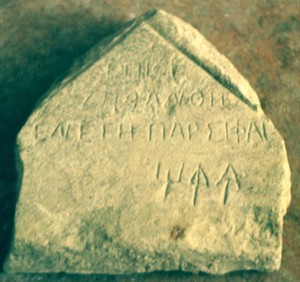 Maximum dimensions of the brick fragment: width 163mm; height 175mm; thickness 43mm. |
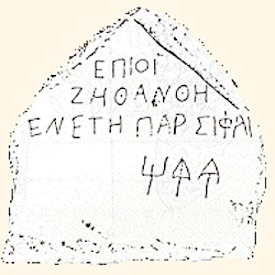 The text appears to be complete. |
Transcription
| In standard Greek script | In modern Roman script |
|---|---|
|
επιοι ζηθανθη ενετη παρ σιφαι vacat 
|
epioi zētʰantʰē enetē par sipʰai vacat
|
There is no doubt about the reading of any of the characters on this stone.
As I stated in the introduction, Marinatos(1958) published an account of the inscription with the first line incorrectly given as επιθι (epitʰi); this incorrect reading was accepted by Davis (1961), C.H. Gordon (1966) and Stieglitz, (1976).
I was aware that Davis had later changed his opinion and read the first line as επιοι (epioi) in his 1967 publication. Nevertheless, I was still expecting to find ΕΠΙΘΙ when I examined the inscription itself in 1976 and was a little surprised to find it not so.
I examined this line very carefully more than once and could find no trace of 'the dot' or any other mark inside the O. I have no doubt at all that the first line reads: ΕΠΙΟΙ.
The only matter of doubt concerns spaces between words in the 3rd line. Even here, one of the spaces is in no doubt: the space between ενετη and παρσιφαι (enetē parsipʰai) is quite definite. This is unquestionably a word division.
Less certain is whether we have a definite word break between παρ (par) and σιφαι (sipʰai); the space here is not as wide as that between ενετη and παρ and may not have been intended as a word division. But σιφαι (sipʰai) is not in quite the same alignment as παρ (par), thus suggesting that the initial σ (s) is beginning a separate word. I did spend some time considering this line and my own opinion, after examining the stone, is that the scribe probably did intended to put a space there.
In his book, Yves Duhoux is in complete agreement with all the above. Of the 1st line, he wrote:
"L'avant-denière lettre est indubitablement ο, et non θ"
and of the two spaces:
"Entre ενετη et παρ existe un blanc, d'un cm, sans parallèle dans le reste de l'inscription, où les blancs ont, au plus, 0,55 ou 0,65 cm. Ce blanc semble donc marquer la séparation des mots."
"Entre παρ et σιφαι, blanc de 0,55 cm. En outre, l'alignement de σιφαι se situe légèrement plus bas que le début de la ligne, et les lettres sont plus serrées que dans le reste de l'inscription. Tout ceci fait pensait que σιφαι pourrait être un mot distinct de παρ."
However, he does also say:
"Entre εν et ετη , blanc de 0,55 cm, qui pourrait mais ne doit pas nécessairement indiquer une séparation de mots."
The gap is rather wider between the bases of the letters than between their tops. When I examined the stone I did not perceive the gap as a word divider.
Comments on words in Greek letters
None of the five (or four or six) words clearly shown here have any obvious parallels with the other Eteocretan inscriptions. Indeed, it is not clear that the language was intended to be the same as that of the Dreros and Praisos inscriptions.
What is more, three of the words can be read as perfectly good ancient Greek words, namely:
- ἐπίοι [verb, optative mood] = may [he/she] come upon, approach; my [he/she] attack.
- ἐνετή [feminine adjective] = inserted; or [feminine noun] = pin, brooch.
- πάρ [preposition] a Doric form of the Classical παρά = [+ accusative] to (the side of); [+ genitive] from (the side of); [+ dative] at (the side of).
It is tempting, therefore, to assume the other two words to be proper names (especially as this gives us a dative case after the preposition) and read it as Greek:
ἐπίοι Zηθάνθη ἐνετὴ πὰρ Σιφᾶι
As the verb ἐπιέναι tends to have a hostile meaning, we might then translate it as:
May [the goddess] Zethanthe go [to be a curse] implanted in Siphas' household
However, if it is so obviously Greek then why is this not generally accepted? I, therefore, asked Dr John Chadwick about this, and in a reply sent to me on the 8th May, 1982, he pointed out that:
- The three Greek words ἐπίοι - ἐνετή - πάρ do not harmonize or make good sense.
- The use of ἐνετή ("inserted") is strained and scarcely acceptable in this context.
- The Doric πὰρ Σιφᾶι (which we would expect from this Doric speaking part of the Greek world) does not harmonize with the Attic-Ionic ἐνετή (Doric ἐνετά ) nor, presumably, with Zηθάνθη.
His conclusion was: "The two proper names are jokers, so the whole must be judged by the rest, and I am sorry to say it fails the test." I submit, however, that the Greek mis-translation is no more strained or incoherent than any of the others I give on the "Translations" of the Epioi text page.
It is not Greek and we have no evidence as to the meanings of any of the words. This, however, has not prevented people from "translating" this inscription. Indeed, as far as I am aware, this inscription, probably because of its apparent completeness, its brevity and the mysterious analphabetic symbols, has attracted more attention from would-be translators than any of the actual Eteocretan inscriptions. Indeed, some translators, in their enthusiasm to produce a "translation", have taken liberties with the word divisions in the 3rd line.
Comments on the symbols
The three symbols belong neither to the known Linear A signary nor to the known Linear B signary. For this reason, some have excluded all connexion with the Linear scripts of Bronze Age Crete. W.C. Brice, for example, concluded that "the group itself would be out of context in that [Linear A] script, and the symbols are of a simple form which might recur independently at any period as craftsmen's marks" (Brice, Gnomon 31, 1959, p. 330).
At the opposite extreme we have authors such as Davis (1961, work cited above), Gordon (1966, work cited above) and Stieglitz (1976, work cited above) who, without any discussion, confidently identified the three symbols as Linear A 100a-56a-78 and read them as i-pi-ti. Later Davis (1967, work cited above) revised his reading, again without discussion, as 100a-61-78 which he read as i-ne-ti.
In between are people like Marinatos (1958, work cited above, p. 228) who found the signs to be Minoan,
but that only  (the first sign) had an exact correspondance with Linear A while the other two were later descendants of the
Linear A system. J. Raison and C. Brixhe (Kratylos 6, 1961, pg. 130) hesitated between "une
sorte de survivance" of Linear A and a magic inscription.
(the first sign) had an exact correspondance with Linear A while the other two were later descendants of the
Linear A system. J. Raison and C. Brixhe (Kratylos 6, 1961, pg. 130) hesitated between "une
sorte de survivance" of Linear A and a magic inscription.
Duhoux (p. 104) rightly observed that, to his knowledge, there was no existence of the use of craftsmen's marks on an inscription and the fact that the three signs do not exactly match Linear A is not a decisive argument against any connexion with Linear A. On the other hand, to identify the symbols with Linear A symbols without discussion and, moreover, to assign them exact values, is not reasonable.
Duhoux systematically considered connexions with "hieroglyphic" Cretan, Linear A and Linear B. I summarize his findings in order to show how unsound some "translations" have been:
- "hieroglyphic" Cretan script:
has no
match.
 has no
match.
has no
match.
 is
similar to sign P 20 (Evans, 1909, p.189), whose value is unknown.
is
similar to sign P 20 (Evans, 1909, p.189), whose value is unknown. - Linear script A
resembles: - 100a whose Linear B homomorph has the value of i;
- 57 whose Linear B homomorph has the value of si.
- has
no strict match but most closely resembles:
- 9 which has no Linear B homomorph;
- 41 whose Linear B homomorph has the value of pi;
- 56a whose Linear B homomorph has the value of pi;
- 67 which has no Linear B homomorph;
- 78 whose Linear B homomorph has the value of ti.
- has
no strict match but most closely resembles:
- 9 which has no Linear B homomorph;
- 36 which has no Linear B homomorph;
- 78 whose Linear B homomorph has the value of ti;
- 79 which has no Linear B homomorph;
- 86 whose Linear B homomorph has the value of ta₂;
- 135 which has no Linear B homomorph.
- Linear script A
- Linear script B
could
correspond to certain varieties of the symbol for i.
could
correspond to certain varieties of the symbol for zo.
has no
obvious likeness to any Linear B sign, but might possibly have evolved from a variety of the sign for si.
It will be seen from the above that possible resemblences with Linear B give us only one reading (1 x 1 x 1 = 1), assuming that, like the Greek letters, the three symbols are to read dextrorsely. If we allow the possiblity of sinistrorse reading of the three symbols, then we have two possible "Linear B related": i-zo-si (dextrorse) or si-zo-i (sinistrorse). I have not found any "translations" that adopt either of these readings, except for the deliberately spoof translations of Michael Hahn (Proto-Egyptian) and Karen Fisher (Classical Chinese).
On the other hand, we have 48 (2 x 4 x 6) dextrorse possibilities if the signs are related to Linear A, with another 48 if we allow the possibility of sinistrorse reading; that is a total of 96 possibilities, which plainly demonstrates how unreasonable it is to assume a "Linear A" reading such as i-pi-ti or i-ne-ti without any proper discussion.
As I observed above, we must assume that the person responsible for this inscription had some familiarity with some of the Linear A inscriptions and appended the three symbols to add mystery to his forgery.
Comments on the inscription as a whole
Rather oddly, in my opinion, some of the earlier "translators" read the three Linear symbols as a repetition of one of the words written in Greek letters, e.g.
- Gordon (1966) read the symbols as i-pi-ti which is supposed to be a repetition of επιθι (epitʰi) = הףתח (htpḥ) "the engraved monument". Quite why the scribe would want to repeat "the engraved monument" is not clear. In any case, as επιθι is a misreading, if indeed the symbols are to be read i-pi-ti they cannot repeat the first line.
- Davis (i961) also read them as i-pi-ti which he supposed repeated the first line; but later (1967), adopting the correct reading of the first line, found that the symbols were i-ne-ti and repeated ενετη (enetē), the first word of the third line, the scribe finding it necessary to repeat "to the goddess".
That the three Linear symbols repeated a word from the text above was supposed to be some sort of confirmation of the correctness of the readings of both the text in Greek letters and of the Linear signs themselves!
But the sad truth is that one can read the three symbols in practically any way one wants. Indeed, they were even read as "confirmation" of an erroneous reading of the Greek letters! There is, of course, no such confirmation possible nor is there any reason to suppose that the three symbols repeat any words in Greek letters.
Another sad truth is that the brevity of the text and the ambiguity of the Linear symbols make it remarkably easy to "translate" this inscription and relate it to any language one wishes with a little imagination and patience.
I once heard a Celtophile claim that Minoan Crete was the birthplace of "Celtic culture". Though I think such a claim absurd, as an experiment many years back I attempted to "translate" the Epioi inscription as "Celtic". It took me just one afternoon to do. I soon "discovered" parallels in Welsh and Cornish, and found that the text in Greek letters asked a question which was answered by the Linear symbols used, of course, to keep the answer hidden from the uninitiated, thus:
"Ah, who takes for thee thy soul that it may stand [in paradise]? THE MAIDEN".
[R.A. Brown, op.cit., Amsterdam, 1984, pages 343 sqq.].
This is not a translation; it is a spoof - a parody of past mistranslations.
We now know that not only is my "translation" is a spoof, but that evidently the inscription itself is a spoof. However, for the curious, I give the various mis-translations cited on this page, including my own, on a separate page.
Eteocretan language pages:
- Welcome to these pages
- The Eteocretan Language
- The Pelasgians
- Archaic Cretan Greek alphabet
- Conventions used in Transcriptions
Inscriptions:
- Dreros #1
- Dreros #2
- Praisos #1
- Praisos #2
- Praisos #3
- Three other Praisian fragments
- The "Epioi" fake
Contents of this page
- Foreword: What I have & have not said not said about this inscription
- Introduction
- The inscription
- Transcription
- Comments on words in Greek letters
- Comments on the symbols
- Comments on the inscription as a whole

 |
Created August 2003. Last revision: Copyright © Ray Brown |