
Eteocretan Language Pages
 Home Page
 Credo pages
 Genealogy
 Eteocretan language
 Glosso-poeia
 "The
"TheOther Praisos Fragments
Introduction
These fragments are included among the Eteocretan inscriptions from Praisos by Margarita Guarducci and given on pages 141 & 142 of Inscriptiones Creticae, Vol. III. She gives no information about when they were found or who found them.
The first two are also given by Yves Duhoux in L'Étéocrétois: les textes - la langue (see bibliographies below); but he lists my Praisos #4 as PRA 5 and my Praisos #5 as PRA 5. He also does give some information about their provenance. He also gives Praisos #6 below as *PRA γ in the chapter "Textes de caractère étéocrétois non assuré" (pages 87-124).
One of the other texts in that chapter is the "Epioi" inscription, which has now been shown to be a modern hoax and is considered on a separate page o this website. I do not consider any of the other texts from that chapter.
Praisos #4 fragment (Duhoux PRA 5)
This was apparently discovered the Italian Archaeological Mission in 1924 in a field in place called Paravoli. It seems it is now lost.
Bibliography
- F. Halberre, 1924, La missione archeologica Italiana in Oreta, Rivista di Filologica e di Istruzione Classica 2 N.S., pages 96-99.
- M. Guarducci, 1942, Inscriptiones Creticae III, Rome, page 141.
- Y. Duhoux, 1982, L'Étéocrétois: les textes - la langue, Amsterdam, pages 82-85.
- R.A. Brown, 1984, Pre-Greek Speech on Crete, Amsterdam, pages 231-232.
This is not an exhaustive bibliography and, as far as I know, none of the above have seen the actual inscription itself.
| Facsimile | |
|---|---|
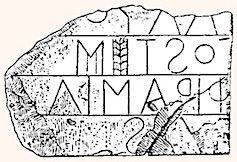 |
Maximum dimensions: width 300mm; height 200mm; thickness 75mm. The inscription was in two parts and appeared to be damaged on all sides. All four lines were written sinistrorsely in an archaic Cretan alphabet of the 6th century BCE. |
Transcriptions
| In standard Greek script | In modern Roman script |
|---|---|
|
|
Notes
- Line 1:
- The first two letters are each either α (a) or γ (g).
- Line 2:
- The first letter is too damaged to read.
- Line 3:
- The second letter looks like ρ (r) but it could be β (b).
- Line 4:
- The line is badly damaged, but the letter after ι (i) seems to be σ (s).

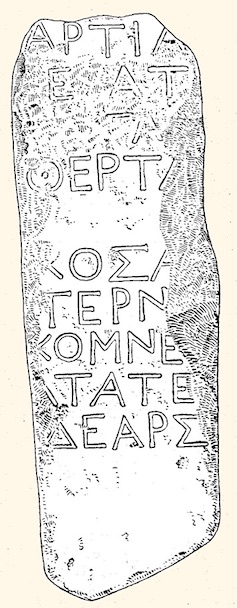
Praisos #5 fragment (Duhoux PRA 4)
According to Duhoux, this was found by R.C. Bosanquet in the ruins of the Muslim village of Βοβίλλοι (which may be an error for Βαβέλλοι) where it had been re-used in a modern building; it is probable that it originated in Praisos.
The inscription is certainly damaged on all sides, but the remaining fragment is whole. All lines written dextrorsely in the Ionian alphabet of the 3rd & 2nd centuries BCE.
It is in the Iraklion Museum: Ἐπιστημονική Συλλογή, inventory #70, i.e. it is not with the Eteocretan inscriptions..
Bibliography
- R.C. Bosanquet, 1909-1910, Inscriptions from Praesos, Annual of the British School at Athens 16, page 287-288.
- R.M. Burrows, 1903-1904, Letter in R.S. Conway, A third Eteocretan fragment (the neikar-inscription), Annual of the British School at Athens 10, pages 124-125.
- M. Guarducci, 1942, Inscriptiones Creticae III, Rome, page 141-142.
- Y. Duhoux, 1982, L'Étéocrétois: les textes - la langue, Amsterdam, pages 80-82.
- R.A. Brown, 1984, Pre-Greek Speech on Crete, Amsterdam, pages 232-233.
This is not an exhaustive bibliography. The first three above have actually seen the inscription itself; I, unfortunately, have not seen it.
| Facsimile | Maximum dimensions: width 115mm; height 480mm; thickness 41mm. | |
|---|---|---|
 |
Transcriptions | |
| In standard Greek script | In modern Roman script | |
|
|
|
| Notes | ||
|
||
Praisos #6 fragment (Duhoux *PRA γ)
Bibliography
- M. Guarducci, 1942, Inscriptiones Creticae III, Rome, page 142.
- Y. Duhoux, 1982, L'Étéocrétois: les textes - la langue, Amsterdam, pages 122-123.
- R.A. Brown, 1984, Pre-Greek Speech on Crete, Amsterdam, pages 233-234.
This is not an exhaustive bibliography and, as far as I know, none of the above have seen the actual inscription itself.
| Facsimile | |
|---|---|
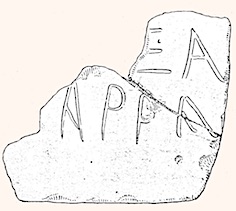 |
Maximum dimensions: width 140mm; height 130mm; thickness 40mm. This inscription is also in two parts and appears to be damaged on all sides except the bottom. Both lines are written dextrorsely. But the inscription is to fragmentary to identify the variety of the alphabet or to date. |
| Transcriptions | |
|---|---|
| In standard Greek script | In modern Roman script |
|
|
| Notes | |
|
|
Comments
- Praisos #4
- If the facsimile and the transcription are correct, then we have evidence of a word ending in φ (pʰ)
and of a complete word ρας (ras) which would mean that the text cannot be Greek and we
have another complete Eteocretan word whose meaning we cannot ascertain.
However, we have to bear in mind that the complete word could be the Greek word βάς ( = ἔβας, Attic-Ionic ἔβης from the verb βαίνω) and that the first letter of the 3rd line is not accurately recorded. In other words, the inscription may be Cretan Doric Greek.
- Praisos #5
- This inscription is so fragmentary that one cannot be certain about the language. The only reason it is considered by
some to be Eteocretan is the supposed instance of the word κομν (komn) in Line 8.
However, the existence of a month called κομνοκάριος in the calendar of the Greek speakers at Dreros reminds us that borrowings in Greek from Eteocretan were always a possibility.
Also, as word divisions are not indicated, we cannot be sure that we even have an instance of κομν; the division may have been -κο μνε- (-ko mne-).
In short, we cannot be sure whether the inscription is Greek or Eteocretan and, even if it is Eteocretan, the fragmentary nature of the inscription and lack of indication of word division tells us nothing useful about the language.
- Praisos #6
This is so very fragmentary that the language cannot be determined. I see no cogent reason to suppose it was not once part of a Greek inscription.
Eteocretan language pages:
- Welcome to these pages
- The Eteocretan Language
- The Pelasgians
- Archaic Cretan Greek alphabet
- Conventions used in Transcriptions
Inscriptions:
- Dreros #1
- Dreros #2
- Praisos #1
- Praisos #2
- Praisos #3
- Three other Praisian fragments
- The "Epioi" fake
Contents of this page

 |
Created August 2003. Last revision: Copyright © Ray Brown |